
Commercial Plumbing SEO: How to Rank for B2B Contracts, Facility Work, and High-Value Commercial Projects
Commercial Plumbing SEO to rank for B2B service contracts, facility plumbing work, industrial maintenance, and high-value commercial project keywords.

Commercial plumbing SEO is nothing like residential SEO. Homeowners search for speed and convenience—businesses search for capability, reliability, compliance, and proof. That means the keywords are different. The pages are different. Even the conversion process is different. Instead of one-off service calls, you’re competing for multi-year maintenance contracts, restaurant plumbing agreements, new construction bids, and emergency commercial repairs that require documentation and trust at every step.
Commercial buyers behave differently too. A facility manager searching for “commercial plumber” is not looking for coupons or drain specials. They want a provider who understands grease traps, commercial water heaters, medical gas, backflow certification, ADA compliance, blueprint coordination, and RFQ processes. If your SEO doesn’t demonstrate those capabilities, you won’t even make the shortlist.
That’s why commercial plumbing SEO wins through authority, clarity, and proof—not speed alone. With the right structure, your site can rank for high-value terms like “commercial plumber,” “restaurant plumbing repair,” “boiler installation,” and “facility maintenance plumbing,” while also positioning your company as the trusted partner GCs, property managers, and business owners rely on.
This guide breaks down how to build pages, case studies, visuals, and authority signals that make Google—and commercial buyers—see you as the go-to expert for B2B plumbing work in your city.
Why Is Commercial Plumbing SEO Completely Different From Residential SEO?
Commercial plumbing SEO targets businesses, facility managers, and GCs—not homeowners. These buyers care about capability, compliance, documentation, and long-term reliability, which means your SEO must communicate authority, not just quick service.
Residential SEO prioritizes speed and convenience. Homeowners want someone who can come today and fix a leak or unclog a drain. Commercial SEO is the opposite. Businesses want a partner who understands:
- Industry regulations
- Safety requirements
- Large-system plumbing
- Grease traps, boilers, backflow, medical gas
- Multi-site maintenance
Where residential plumbing SEO relies on emotion and urgency, commercial SEO relies on evidence and capacity. Commercial buyers evaluate:
- Past project examples
- Case studies
- Insurance and licensing details
- Response protocols
- Industries served
- Equipment capability
Another major difference is sales cycle length. A homeowner may book in minutes. A commercial client may take weeks. Your SEO must guide them through a slower, documentation-heavy decision process.
Google also treats commercial intent differently. Broad keywords like “plumber near me” skew residential. But “commercial plumber” or “restaurant plumbing repair” trigger entirely different ranking factors—favoring companies with:
- Industry pages
- Project photos
- Capability statements
- Backflow or grease trap certifications
Commercial plumbing SEO isn’t harder—it’s just built for a completely different type of customer.
What Commercial Plumbing Keywords Lead to Real Contracts?
The commercial plumbing keywords that drive real contracts are those tied to capability, equipment, and industry-specific problems—not generic plumbing terms. These keywords attract facility managers, restaurants, property managers, and GCs looking for long-term partners rather than one-off service calls.
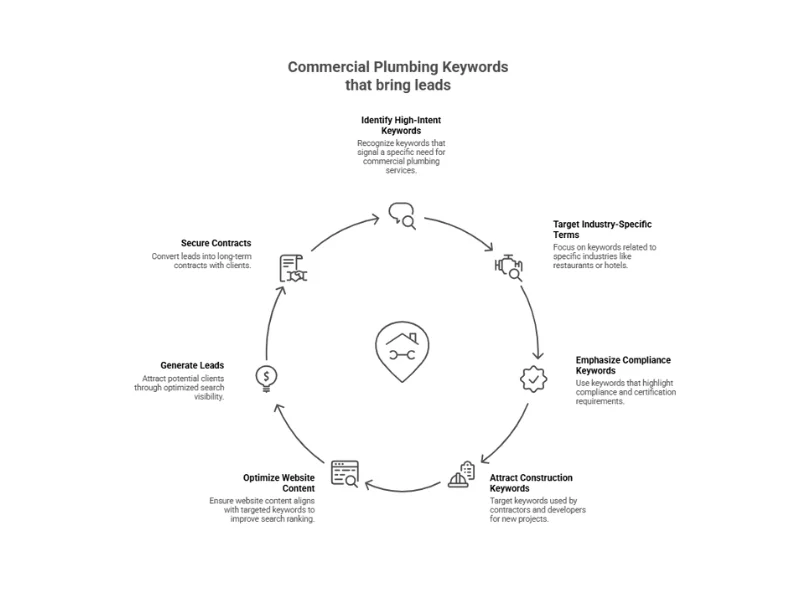
High-value commercial searches fall into four categories:
1. Core Commercial Plumbing Keywords (High Intent)
These signal someone looking specifically for a commercial plumbing provider:
- commercial plumber [city]
- commercial plumbing company
- commercial plumbing contractor
These are the contract-winning terms.
2. Industry-Specific Search Terms
Businesses search based on their environment, not by generic service names:
- restaurant plumbing repair
- commercial kitchen drain service
- office restroom plumbing
- school plumbing maintenance
- hotel plumbing contractor
Industry intent pages rank extremely well because competitors rarely build them.
3. Compliance & Specialty Keywords
Commercial environments require documented, certified, regulated work:
- backflow testing and certification
- grease trap service / grease interceptor cleaning
- medical gas plumber
- boiler installation / commercial water heater install
These searches often lead to repeat annual or quarterly service agreements.
4. Construction & Contractor Keywords
GCs and developers search differently than business owners:
- plumbing for new construction
- tenant improvement plumbing
- commercial rough-in plumbing
- plumbing subcontractor [city]
These keywords unlock multi-month projects with high margins.
Commercial SEO lives and dies by intent clarity.
If your website only targets “plumber near me,” you’ll never surface for the terms that matter to B2B buyers.
What Pages Do You Need to Rank for High-Value Commercial Plumbing Work?
To rank for real commercial plumbing contracts, you need more than a generic “Commercial Plumbing” page. Google—and B2B buyers—expect a structured system of capability pages, industry pages, and specialty pages. Without them, your site appears residential-focused, and you won’t rank for commercial searches.
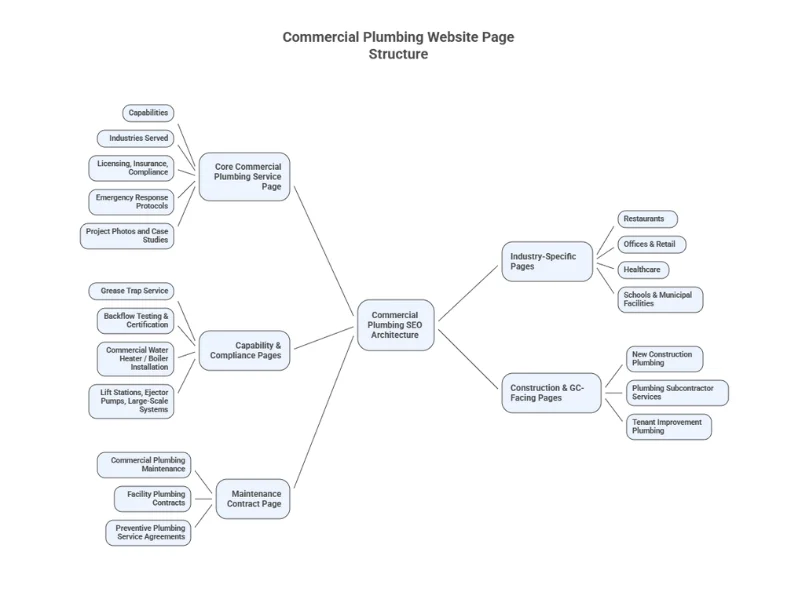
At minimum, your commercial plumbing SEO architecture should include:
1. A Core Commercial Plumbing Service Page
This is the page that targets your main keyword (e.g., commercial plumber [city]). It should highlight:
- Capabilities
- Industries served
- Licensing, insurance, compliance
- Emergency response protocols
- Project photos and case studies
This is your commercial “hub.”
2. Industry-Specific Pages (High Differentiation)
These pages match how actual commercial buyers search. They should address the problems unique to each environment:
- Restaurants – grease traps, floor drains, kitchen plumbing
- Offices & retail – restrooms, fixtures, supply lines
- Healthcare – medical gas, sterilization requirements
- Schools & municipal facilities – large restrooms, old infrastructure
These pages dramatically increase conversions because the buyer feels understood.
3. Capability & Compliance Pages (Trust Builders)
Commercial clients need proof you can handle regulated work:
- Grease trap service
- Backflow testing & certification
- Commercial water heater / boiler installation
- Lift stations, ejector pumps, large-scale systems
These pages signal that you are more than a residential plumber.
4. Construction & GC-Facing Pages
These pages attract general contractors and developers:
- New construction plumbing
- Plumbing subcontractor services
- Tenant improvement plumbing
Including blueprint coordination, timelines, and safety protocols is essential.
5. Maintenance Contract Page
Facility managers want recurring support, not one-off visits. A dedicated Service Agreements page helps you rank for:
- commercial plumbing maintenance
- facility plumbing contracts
- preventive plumbing service agreements
This is where recurring revenue starts.
When these pages exist together, Google sees depth, businesses see capability, and you rise above residential-focused competitors instantly.
How Should a Commercial Plumbing Landing Page Be Structured to Win B2B Leads?
A commercial plumbing landing page must show capability, compliance, and proof within the first few seconds. Unlike homeowners, commercial buyers don’t care about coupons or quick fixes—they care about whether you can handle their building, their systems, and their liability requirements.
The top of the page should immediately communicate who you serve and what you can handle. A strong opening includes:
- A clear capability statement
- Industries served
- Licensing, insurance, and compliance badges
This instantly signals professionalism.
Next, you need to address the problems commercial clients face. Restaurants worry about grease trap backups; offices worry about restroom downtime; healthcare facilities worry about regulations and sanitation. When your landing page reflects these concerns, buyers feel understood and trust builds quickly.
Visual proof is essential. Unlike residential jobs, commercial plumbing requires:
- Project photos (boilers, utility rooms, grease interceptors, piping)
- Before/after work on large systems
- Documentation examples (permits, inspection reports)
These visuals remove doubt and separate you from residential competitors.
Add a short section outlining response expectations—how quickly you respond to emergencies, how you handle after-hours calls, and how communication works during large projects. Commercial clients value predictability above all else.
Finally, include case studies or mini-project summaries. They offer the most persuasive evidence that you’ve successfully handled similar environments.
A great commercial landing page doesn’t try to “sell” the service.
It proves credibility, scope, and reliability—three things every B2B plumbing buyer needs.
How Do Industry-Specific Pages Improve Commercial Plumbing Rankings?
Industry-specific pages rank better because commercial buyers search by environment, not by general plumbing terms. Restaurants, offices, schools, and healthcare facilities have different problems—and when your website speaks their language, Google sees you as the relevant expert for each niche.
For restaurants, problems revolve around grease, kitchen backups, and floor drains. A Restaurant Plumbing page should highlight grease trap services, line jetting, and compliance with local health regulations. When a restaurant owner sees terminology they recognize, trust builds fast.
Office and retail plumbing needs are different. These clients care about restrooms, fixture reliability, supply line maintenance, and minimal business disruption. A dedicated Office & Retail Plumbing page shows that you understand high-traffic commercial environments.
Healthcare facilities require even more specialization. A Healthcare / Medical Plumbing page must reflect medical gas handling, sterilization plumbing, compliance, and certification requirements. Most competitors don’t touch this niche—so ranking becomes easier if you show proof and competency.
Schools and municipal buildings have their own challenges: aging infrastructure, high-usage restrooms, and strict approval processes. A School / Municipal Plumbing page signals that you can navigate large systems and documentation-heavy jobs.
These pages aren’t about adding volume—they’re about adding precision.
They let Google match your business to the exact type of commercial buyer searching.
The result:
Higher relevance → stronger rankings → bigger, contract-driven projects.
How Should You Use Case Studies in Commercial Plumbing SEO?
Case studies are one of the strongest ranking and conversion tools for commercial plumbing because they prove you can handle complex, compliance-driven work. Commercial buyers don’t trust claims—they trust documented outcomes, timelines, and before/after evidence.
A strong case study follows a simple structure: problem → process → solution. Start by describing the environment—a restaurant, school, medical facility, or commercial building—and the issue at hand. This tells Google (and the buyer) exactly what industries you serve.
Next, outline the process. Commercial clients care about logistics: how you diagnosed the issue, coordinated with staff or GCs, handled safety protocols, and managed downtime. Even a brief description of steps shows competence at a level residential plumbers don’t display.
Visuals matter just as much. Include:
- Jobsite photos
- Equipment shots (boilers, jetters, medical gas manifolds)
- Before/after comparisons
- Blueprint snippets or inspection reports (when appropriate)
These images are gold for both SEO and trust.
Finally, present the outcome: restored service, compliance met, system upgraded, or downtime avoided. Adding a short testimonial—especially from a known business—dramatically increases conversion rates.
Case studies aren’t filler content.
They position you as a proof-driven provider, which is exactly what commercial clients—and Google—want to see.
How Does Google Business Profile Influence Commercial Plumbing Rankings?
Google Business Profile (GBP) influences commercial plumbing rankings by signaling your capabilities to both Google and B2B buyers. Even though many commercial searches happen on desktop, the Map Pack still captures high-intent queries like “commercial plumber,” “backflow testing,” and “grease trap service.”
The key is teaching GBP that you are not a residential plumber. That starts with choosing the right secondary categories. Adding “Plumbing Contractor,” “Drainage Service,” “Grease Trap Service,” or “Backflow Testing Provider” helps Google associate your profile with commercial work.
Photos matter more than most commercial plumbers realize. Businesses want to see:
- Utility rooms
- Boilers and commercial water heaters
- Grease interceptors
- Backflow assemblies
- Large piping or underground work
- Jobsite coordination
These images send strong topical signals and immediately differentiate you from residential competitors uploading faucet replacements and kitchen sinks.
Review language is another ranking lever. When clients mention terms like commercial building, restaurant, grease trap, or boiler install, Google uses those keywords to classify your profile. The more commercial-specific your reviews, the stronger your Map Pack visibility becomes.
Posting regular updates also helps. Even short job summaries or photos of equipment show activity—something many commercial competitors neglect entirely.
GBP may not feel like a “commercial platform,” but it shapes first impressions and ranking opportunities.
A well-optimized profile signals capability, specialization, and trust—three qualities every commercial buyer looks for.
How Do Backlinks Work Differently for Commercial Plumbing SEO?
Commercial plumbing backlinks must come from businesses, construction networks, and industry partners—not generic blogs. Google ranks commercial plumbing pages higher when your backlinks reflect real-world commercial relationships.
Residential plumbing thrives on volume; commercial plumbing thrives on relevance. A single backlink from a property management firm or GC carries more authority than dozens of low-quality directory links. These relationships signal that your company is trusted for large-scale, compliance-based work.
Strong commercial backlink sources include:
- Property management companies
- Restaurant groups and hospitality associations
- General contractors and subcontractors
- Engineering or architectural firms
- Restoration companies
- Local construction directories
These links mirror the ecosystem commercial plumbers actually operate in.
Industry-specific organizations are especially powerful. Listings or mentions from mechanical contracting associations, construction networks, or local building councils show Google that your company is vetted and connected.
What doesn’t help?
Backlinks from irrelevant sites, lifestyle blogs, or national directories with no commercial context. These may help residential plumbing SEO but do almost nothing for commercial ranking signals.
To rank for commercial keywords, your backlink profile must look like a contractor’s, not a home-service provider’s.
Authority replaces quantity, and relevance replaces broad outreach.
How Should You Target Facility Managers, Property Managers & GCs?
Facility managers, property managers, and general contractors search and evaluate vendors differently from homeowners. They focus on reliability, documentation, response protocols, and long-term capability. Your SEO must speak directly to their expectations—not residential concerns.
Start by creating service pages that address how you work with commercial decision-makers. These pages should highlight response times, communication processes, documentation readiness, and your ability to coordinate with other trades. Commercial buyers want to see that you can integrate into their workflow without disrupting operations.
Your messaging should reflect what these groups care about most:
- Predictability (scheduled maintenance, defined response windows)
- Compliance (backflow certifications, permits, safety training)
- Communication (project updates, contact protocols, invoicing clarity)
- Capability (equipment lists, lift stations, boilers, grease systems)
This is the type of information they use to evaluate vendors.
For GCs, you need a dedicated Plumbing Subcontractor or New Construction Plumbing page. Include blueprint coordination, jobsite safety protocols, and examples of past projects. GCs look for trades who won’t slow down their timeline.
For property managers, create content around multi-site service, preventive maintenance, and tenant responsiveness. These are their biggest pain points.
Facility managers respond well to pages that highlight:
- Service plans
- Inspection procedures
- Documentation retention
- Equipment capability
Beyond your site, add LinkedIn optimization. Many commercial buyers use LinkedIn to vet contractors, check legitimacy, and see project history.
Commercial SEO doesn’t chase quick jobs—it positions you as the vendor they trust long-term.
How Should You Use Project Photos & Videos to Boost Commercial Rankings?
Project photos and videos are essential for commercial plumbing SEO because they demonstrate capability at a scale residential competitors can’t match. Commercial buyers want to see proof of equipment, safety, and complexity—not staged images of kitchen faucets.
Start by showcasing real job environments. Commercial utility rooms, boiler installs, grease traps, lift stations, trenching, and large-diameter piping immediately signal that you can handle heavy-duty work. Google also reads these images as relevance signals for commercial keywords.
Videos work especially well for B2B audiences. A 10–20 second clip showing a boiler startup, a grease trap cleanout, or blueprint walkthrough gives buyers confidence that you can execute professionally on job sites. These clips also increase dwell time, which supports SEO performance.
Your project visuals should include:
- Before/after repairs in commercial settings
- Large commercial water heater or boiler installs
- Grease interceptor cleanouts
- Backflow assemblies and certification processes
- Underground or trenchless work
- Crew coordination on job sites
These aren’t just marketing assets—they’re ranking assets.
Case studies should integrate photos and videos to strengthen credibility. When a commercial buyer sees visuals that match their environment, they know you can handle their building without guesswork.
Consistent visual content tells Google—and commercial clients—that you’re active, capable, and experienced with high-value systems.
What On-Page SEO Elements Matter Most for Commercial Plumbing?
The most important on-page elements for commercial plumbing are those that prove capability and relevance to complex environments. Unlike residential pages, commercial pages need structured content that communicates scale, compliance, and industry expertise.
Start with a strong capability statement near the top of the page. Commercial buyers want to know if you handle boilers, backflow, grease traps, medical gas, lift stations, or tenant improvement projects. Listing these capabilities early helps both Google and buyers understand your scope.
Next, include an Industries Served module. This section tells Google exactly which commercial environments you optimize for and reinforces your relevance for searches like “restaurant plumbing repair” or “school plumbing contractor.” It also reassures buyers that you understand their world.
On-page credibility is essential. Your page should show:
- Licensing and insurance details
- Safety certifications (OSHA, confined space, etc.)
- Equipment lists (jetters, boilers, lift stations, camera equipment)
- Service coverage zones or maps
These elements differentiate you from residential-focused plumbers.
Internal links are also critical. Link your commercial service page to your:
- Grease trap page
- Backflow page
- Boiler installation page
- New construction plumbing page
- Industry-specific pages
This creates a topical cluster that strengthens your authority across all commercial keywords.
Google evaluates commercial pages through the lens of expertise and operational capability. When your on-page structure reflects that, rankings and conversions improve quickly.
How Do Commercial Plumbing Maintenance Plans Strengthen SEO?
Commercial plumbing maintenance plans strengthen SEO because they create recurring search intent, build topical authority, and attract long-term clients who want predictable service—not one-time repairs. Google rewards businesses with clear, structured service offerings, and maintenance plans reinforce your relevance for commercial environments.
The first benefit is keyword expansion. Maintenance-related terms such as “facility plumbing maintenance,” “restaurant plumbing contracts,” “commercial service agreements,” and “preventive plumbing services” open new ranking opportunities that competitors rarely target. These keywords bring in high-value leads who are looking for ongoing support.
Maintenance plan pages also build credibility. Commercial clients want documentation, scheduled inspections, and fast response protocols. When your content outlines these expectations clearly, Google views your site as more helpful and authoritative for B2B intent.
A strong maintenance plan page should highlight:
- Scheduled drain cleaning or grease trap service
- Quarterly or annual backflow testing
- Commercial water heater or boiler inspections
- Emergency response windows
- Facility-wide plumbing assessments
These details signal a long-term partner, not a one-off vendor.
Internal linking further boosts authority. Your maintenance plan page should connect to your industry pages (restaurants, offices, schools) and your capability pages (grease traps, backflow, boilers). This creates a strong content cluster, signaling to Google that you specialize in commercial systems.
Recurring services also translate into stronger reviews from commercial clients, which reinforces your Map Pack performance—especially for commercial keywords.
In short, maintenance plans stabilize revenue and strengthen SEO simultaneously. Google sees consistency. Buyers see reliability. You win both.
What Technical SEO Issues Hurt Commercial Plumbing Rankings the Most?
The biggest technical SEO problems for commercial plumbing are slow media-heavy pages, missing trust signals, and thin industry content. Commercial buyers expect detailed proof, and Google won’t rank you without a technically clean, capability-focused site.
One of the most common issues is slow-loading galleries and project photos. Commercial plumbing pages depend on visuals—boilers, grease traps, underground piping, blueprint coordination—but uncompressed images and videos drag down site speed. Slow pages hurt both rankings and conversions, especially on mobile where many facility managers still browse.
Another major problem is missing schema markup. Commercial services need:
- LocalBusiness schema
- Service schema for grease traps, boilers, backflow, new construction
- FAQ schema for RFQs, maintenance questions, and compliance topics
Without schema, Google struggles to understand your scope, and you lose rich result opportunities.
Industry pages often suffer from thin content, which signals low expertise. A single paragraph on “Restaurant Plumbing” or “School Plumbing” won’t convince Google—or a buyer—that you handle complex environments.
Other damaging issues include:
- Missing capability statements on pages
- No internal links between commercial service clusters
- PDFs replacing actual web content (Google can’t rank a PDF well)
- Navigation that hides or buries commercial pages
Technical SEO for commercial plumbing isn’t about advanced tricks—it’s about ensuring your expertise is clear, fast, and easy to crawl.
Fix the friction, and your commercial pages gain authority much faster.
How Long Does Commercial Plumbing SEO Take to Produce Results?
Commercial plumbing SEO typically takes 90–180 days to show strong results because B2B keywords require authority, proof, and industry-specific relevance. Unlike residential SEO—which can move faster—commercial SEO demands deeper content and stronger trust signals.
Commercial keywords take longer because Google looks for:
- Industry pages
- Case studies
- Compliance indicators
- Jobsite photos and videos
- Specialized services (backflow, grease traps, boilers)
Until you build this content ecosystem, Google sees you as a general plumber rather than a commercial provider.
The Map Pack also moves slower for commercial terms. Reviews carry more weight, especially those mentioning:
- Restaurants
- Schools
- Commercial buildings
- GCs or new construction projects
If you lack commercial-specific reviews, Google won’t confidently rank you for B2B terms.
Timelines also depend on competition. In markets with strong commercial plumbing companies, Google prioritizes those who consistently post project photos, publish case studies, and maintain complete industry pages.
However, once the content structure is built, commercial SEO becomes more stable than residential SEO.
Fewer companies compete for commercial terms, fewer pages are optimized correctly, and buyers tend to stay loyal once you’ve proven capability.
So while it takes longer upfront, the results last much longer—and the contract value is far higher.
Should Commercial Plumbing SEO Be Done In-House or With a Specialist?
Most plumbing companies struggle to manage commercial SEO in-house because the niche requires industry-specific content, compliance-driven messaging, and case-study development—work that general agencies or internal staff rarely have time or expertise to produce.
Commercial SEO is fundamentally different from residential SEO. It demands a deep understanding of how facility managers, property managers, and GCs evaluate vendors. That means your content must speak to permits, documentation, timelines, safety protocols, and equipment capability—not just “fast service.”
Doing this internally means you must consistently produce:
- Industry pages for restaurants, offices, schools, and healthcare
- Photo and video documentation of commercial jobs
- Case studies with scope, timelines, and compliance details
- Capability statements and equipment lists
- Content that aligns with RFQ and bid processes
Most teams simply cannot maintain this output while also running field operations.
General marketing agencies often fail for a different reason—they don’t understand commercial plumbing. They write broad “services pages” that sound residential, ignore industry-specific terminology, and skip the visuals and case studies buyers rely on.
A plumbing-focused SEO specialist already knows:
- The language commercial buyers expect
- How to structure capability and industry pages
- How to leverage grease trap, backflow, boiler, and TI content
- What visuals boost trust and Map Pack performance
- How to turn project photos into ranking assets
- How to structure multi-location and multi-industry internal links
Commercial SEO succeeds when the content reflects real operational capability.
If SEO doesn’t mirror how commercial plumbing actually works, it won’t rank—and it won’t win contracts.
For most companies, hiring a specialist isn’t an upgrade…
It’s the only way to compete with established commercial contractors.
What Are the Most Dangerous SEO Mistakes in Commercial Plumbing Marketing?
The most dangerous SEO mistakes in commercial plumbing happen when companies present themselves like residential plumbers. Commercial buyers need capability, compliance, and documentation, and anything less causes Google—and decision-makers—to skip your business entirely.
The first major mistake is having only one generic “commercial plumbing” page. This page alone cannot rank for restaurant plumbing, backflow testing, medical gas, or new construction. Without industry-specific and capability-specific pages, Google won’t consider you relevant for commercial searches.
Another harmful mistake is using residential-style photos. Images of faucet repairs, home bathrooms, or kitchen sinks tell Google—and commercial buyers—that you don’t handle large systems. Lack of commercial visuals is one of the fastest ways to destroy credibility.
Content thinness is another problem. Many companies list services without explaining:
- Response protocols
- Compliance requirements
- Equipment used
- Past projects or case studies
- Industry challenges
Without depth, Google assumes you don’t specialize.
Other high-impact mistakes include:
- No backflow, grease trap, or boiler-focused pages
- Hiding commercial pages deep in the menu
- PDFs replacing high-value content
- No capability statement above the fold
- No internal links connecting commercial service clusters
Perhaps the biggest mistake is failing to show proof of experience. Commercial clients need to see real job photos, documentation, safety practices, and installation work before they reach out.
In commercial plumbing SEO, authority is everything.
If your content doesn’t demonstrate it, competitors will—leaving you invisible in the searches that matter most.
How Do Commercial Plumbing Pages Feed Your Entire Plumbing Business?
Commercial plumbing pages feed your entire business by driving long-term contracts, recurring maintenance revenue, and high-ticket projects that stabilize cash flow. Unlike residential work—where each job stands alone—commercial relationships compound over time.
A single commercial plumbing lead can open multiple revenue paths. For example, a restaurant needing a grease trap service may later request quarterly drain maintenance, water heater replacements, or emergency after-hours support. Offices and retail buildings require fixture upgrades, restroom renovations, and ongoing repairs. Schools, warehouses, and healthcare facilities often sign multi-year maintenance agreements.
Here’s how one commercial page can multiply revenue opportunities:
- Facility manager searches “commercial plumber [city]” → finds you
- That manager hires you for a repair
- You identify additional needs during routine service
- You propose a maintenance plan
- You become the default provider for all plumbing issues
This is a compounding ROI model.
General contractors and developers also enter through these pages. A GC might find your new construction plumbing page and invite you to bid. One TI (tenant improvement) job often leads to multiple projects because GCs prefer reliable subs.
Commercial SEO strengthens your entire site as well. Industry pages, case studies, and project photos boost topical authority, which improves visibility for all plumbing services—including residential ones.
Commercial SEO doesn’t just generate leads.
It creates relationships that feed your business quarter after quarter, year after year.
Related: Emergency Plumbing SEO
Frequently Asked Questions About Commercial Plumbing SEO
Do I need industry-specific pages to rank for commercial plumbing searches?
Yes. Google ranks pages based on relevance, and industries have unique plumbing needs. Dedicated pages for restaurants, offices, schools, and healthcare dramatically improve rankings and conversions because they match real B2B intent.
Do case studies actually help commercial plumbing SEO?
Absolutely. Case studies provide proof of capability, which Google and commercial buyers both rely on. They increase dwell time, strengthen topical authority, and help you win high-value contracts.
Why do commercial plumbing keywords take longer to rank?
Commercial terms require more authority signals—project photos, compliance details, capabilities, and industry depth. Google must confirm you’re equipped for complex systems before ranking you for B2B queries.
Does Google Business Profile matter for commercial plumbing?
Yes. Many commercial queries trigger Map Pack results. GBP categories, photos of commercial job sites, and reviews mentioning commercial work help you rank higher and attract B2B buyers.
Do I need separate pages for grease traps, backflow testing, or boilers?
Yes. These are high-intent commercial services with their own search demand. Separate pages help Google understand your capabilities and improve your chances of ranking for contract-level work.
Is backlink building different for commercial plumbing SEO?
Very. The best links come from property managers, GCs, restaurant associations, and construction networks—not general directories. These links reflect real commercial relationships and carry far more authority.
Should commercial SEO highlight equipment and capabilities?
Yes. Listing equipment (jetters, boilers, camera systems) and capabilities (medical gas, trenching, TI work) signals to Google and buyers that you handle complex commercial systems.